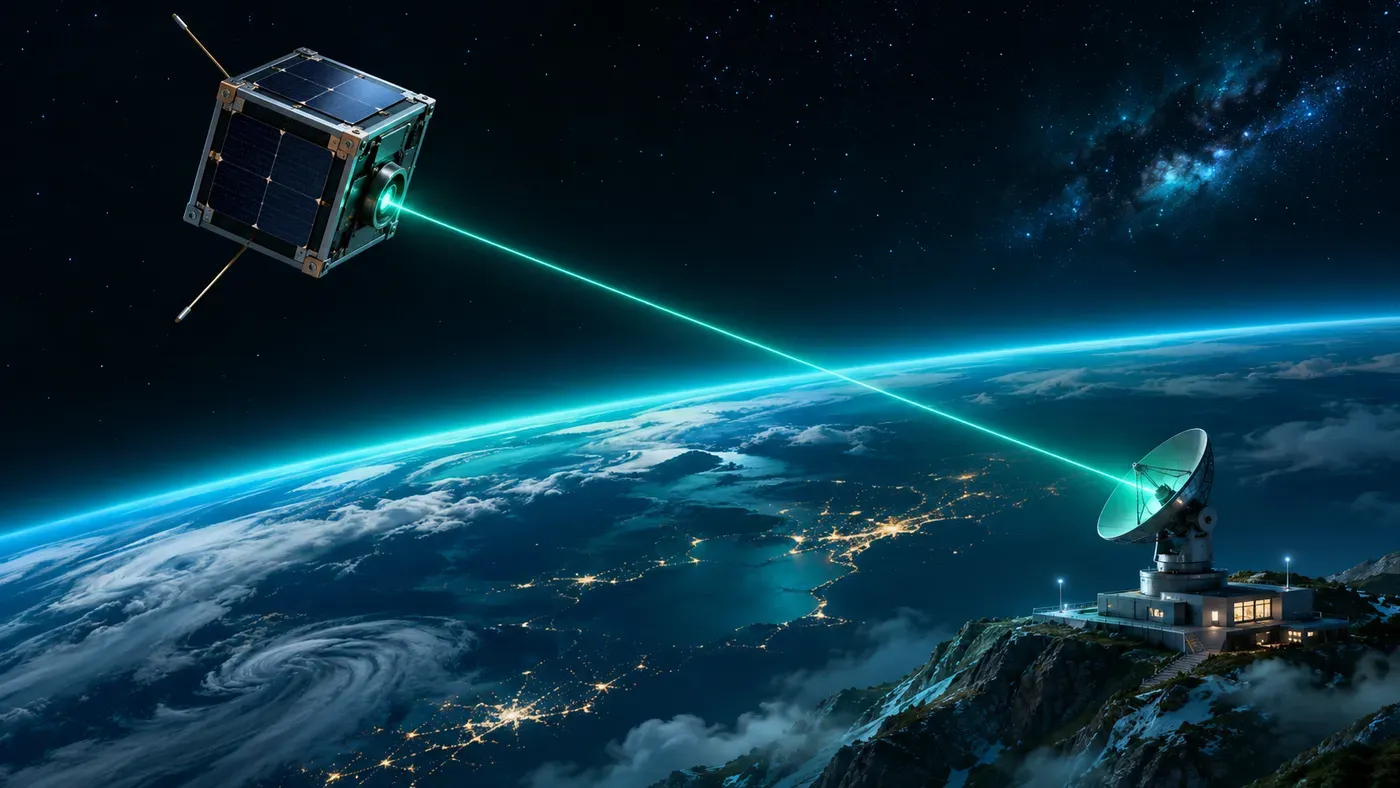
A small satellite, a precise connection
A Greek research satellite has established an optical link with a ground station, according to a November update from the European Space Agency. ERMIS-3 is an 8U CubeSat developed by the National and Kapodistrian University of Athens with ESA support. Lithuanian company Astrolight supplied the satellite’s optical terminal and ground equipment.
The link connected the spacecraft with the Holomondas Optical Ground Station in Greece. ESA says contact was achieved on the first active pass after commissioning, with routine operations established within a week.
Why use lasers?
Optical communication can offer high-capacity connections without relying on the same radio-frequency spectrum used by many satellite systems. The trade-off is precision: a satellite moving rapidly across the sky and a ground receiver must point, acquire, and track each other accurately. Weather and clouds also complicate operations.
ESA reports that the system now operates autonomously with two links per day and margins for up to 10 gigabits per second. That figure describes the stated system margin, not a claim that every pass delivered a measured 10-gigabit data transfer.
A European collaboration
The demonstration connects university research, Lithuanian optical hardware, a Greek ground station, and ESA engineering support. For future Earth-observation missions, stronger downlinks could help move larger image datasets to researchers, provided the technology remains reliable across varied conditions.
Source
Cover image: AI-generated conceptual illustration.