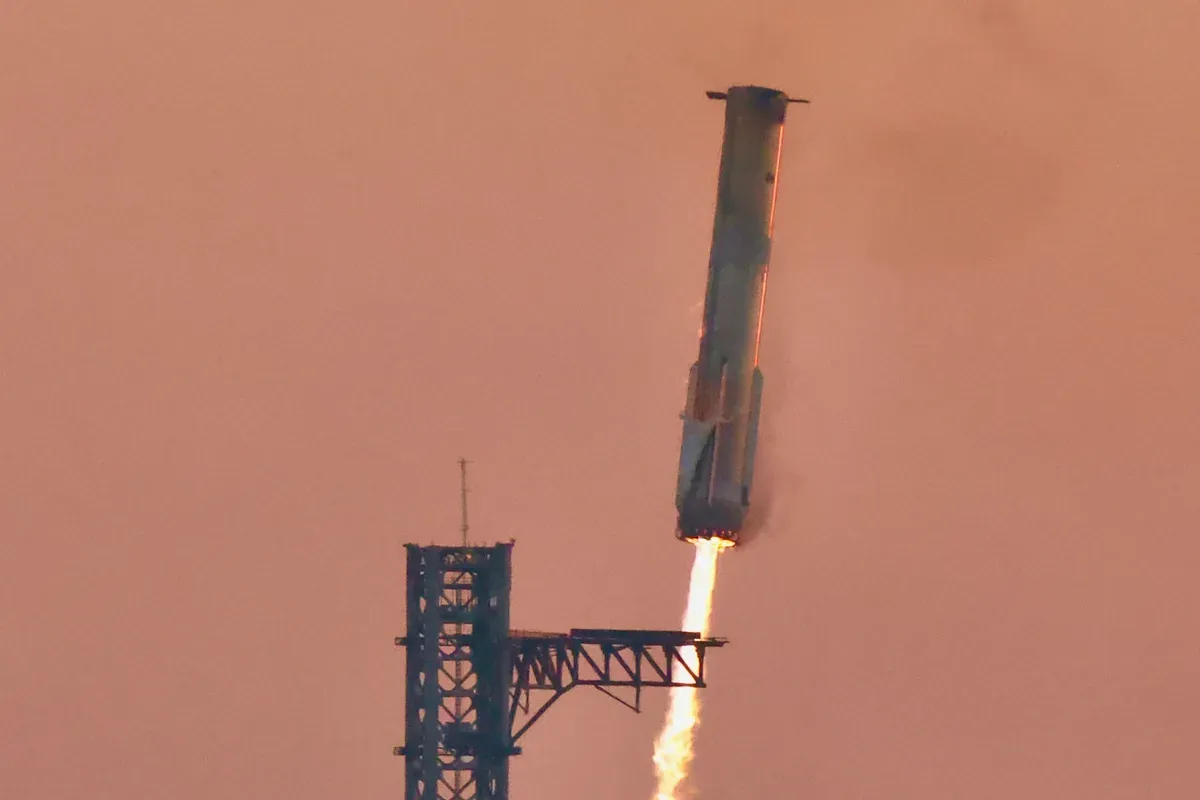
SpaceX caught the upper stage of its Starship rocket at its launch tower on November 14, 2026, after the vehicle returned from orbit. The recovery during Flight 15 was a first for the spacecraft portion of the two-stage system—and an important test of the company’s goal of reusing more of its rockets.
The flight did not deliver a complete two-stage recovery. The Super Heavy booster’s planned return was aborted, and the booster was lost over the Gulf of Mexico. That makes the outcome both a meaningful spacecraft recovery and a reminder that reliable reuse remains work in progress.
What happened during Flight 15
Starship launched from Starbase, Texas, on November 13. After separation, the upper stage continued into orbit, deployed 26 Starlink satellites and circled Earth 14 times before returning approximately 22 hours after launch, according to Associated Press reporting.
On its way back, the spacecraft had to survive reentry, navigate toward the launch site, reorient for a powered descent and approach the tower precisely enough for its mechanical arms to catch it. Aerospace America reports that the vehicle was caught at the launch site after completing its orbital flight.
Why a ship catch is different from a booster catch
Starship is the name used both for the full launch system and for its upper-stage spacecraft. Super Heavy is the booster that provides the initial push off the ground. SpaceX has caught Super Heavy boosters before; this event involved the separate upper stage, which travels into orbit and returns through the atmosphere at much higher speed.
That extra journey makes heat protection and precise return especially important. A tower catch is a recovery method, not proof that a vehicle can be inspected, refueled and flown again quickly. The company will still need to show repeatable flights, maintenance requirements and safe operations across many missions before rapid reuse can be evaluated in practice.
The booster outcome—and what remains unproven
The booster’s catch attempt was called off after a problem during its return. Aerospace America reported that an early indication was a low-fuel-mass alarm, while SpaceX was still investigating the cause. It is too early to treat that preliminary explanation as a completed accident finding.
For NASA, a dependable Starship system matters because the agency has selected a Starship variant for lunar landing missions. For satellite operators, a vehicle that can be reused reliably could eventually change launch economics and capacity. Those benefits depend on future demonstrations, regulatory approvals and operational costs—not on one catch alone.
Sources and image credit
Associated Press: Starship returns from orbit and is captured · Aerospace America: SpaceX achieves first Starship tower catch · SpaceX: Flight 15 mission page
Cover photo: Starship Booster Return on Final Approach by Steve Jurvetson, CC BY 2.0. The image shows the Super Heavy booster during Flight 5 in October 2024, not the Flight 15 upper-stage catch. The Wikimedia crop was resized, cropped further, and converted to WebP.